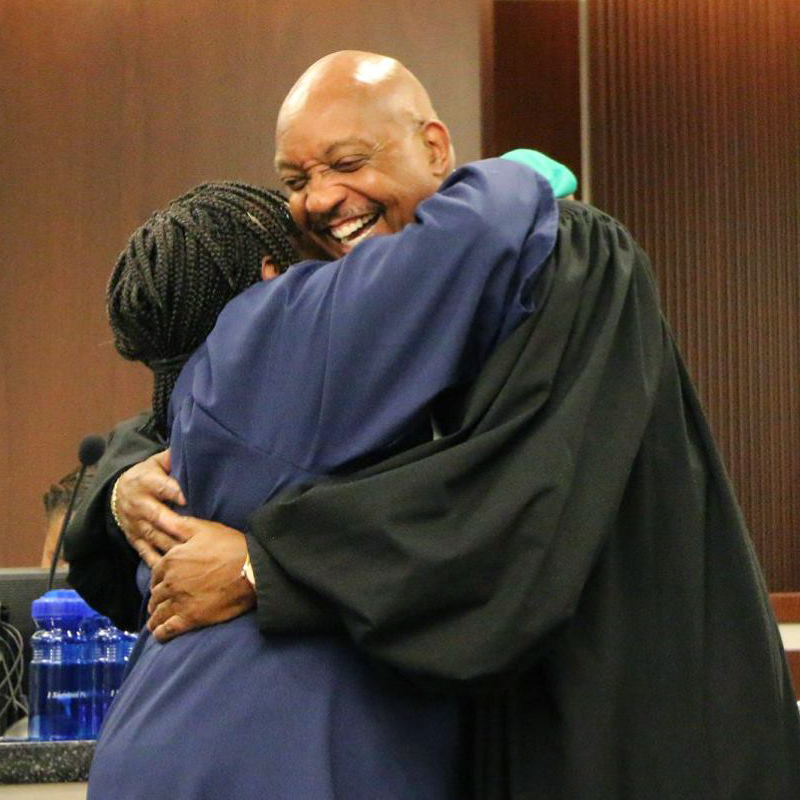
The Buffalo Veterans Treatment Court in action

Contact Us:
Policy/Partnerships
Matt Stiner
571-384-1858
Training/Technical Assistance
Brian Clubb
571-384-1852
Media
Chris Deutsch
571-384-1857
Veterans Treatment Court Planning Initiative
The Veterans Treatment Court Planning Initiative (VTCPI) is designed to assist jurisdictions in the planning and development of Veterans Treatment Court programs. NDCI staff and a cadre of Veterans Treatment Court practitioners work with planning teams to shape their programs, develop their policy and procedure manuals, and build team unity. Learn more.
Veterans Treatment Court Mentor Court Program
NADCP and its professional services branch, the National Drug Court Institute (NDCI), is proud to announce the formation of the new NDCI Veterans Treatment Courts Mentor Court Program. Developed in collaboration with the Center for Substance Abuse Treatment (CSAT) within the Substance Abuse and Mental Health Services Administration (SAMHSA), Mentor Veterans Treatment Courts will play a significant role in Veterans Treatment Court training, technical assistance and research. Learn more.
![]()
Justice For Vets SITREPs
The military uses SITREPs, or Situation Reports, to keep personnel apprised of what is occurring in and around military units. Justice for Vets will use this same tool to keep you informed of important developments within the Veterans Treatment Court movement to include news, legislation, media coverage, resources, funding opportunities, special events and more. You can also download the latest SITREPs by clicking here.
If you would like to be added to the Justice For Vets distribution list, email Matt Stiner at mstiner@justiceforvets.org.
![]()
*NEW WEBINAR*Post-Traumatic Stress Disorder with Dr. Casey Taft
The first portion of this webinar will provide an overview of Post Traumatic Stress Disorder (PTSD), including diagnostic features, the identification of biomarkers for PTSD, and interventions f
or PTSD. The second portion of the webinar will focus on how trauma and PTSD may impact the family and interventions to prevent family conflict and domestic violence will be discussed.
Watch this webinar
Download the Powerpoint Slides Here
![]()
Key Components of Veterans Treatment Courts
In January, 2008, the Buffalo Veterans Treatment Court became the first Veterans Treatment Court in the nation. By combining the key components of Drug Courts (Defining Drug Courts: the Key Components), and the ten essential elements of Mental Health Courts, the Buffalo Veterans Treatment Court developed ten key components of a Veterans Treatment Court.
The Buffalo Veterans
Treatment Court Policy and Procedure manual has information on Buffalo's court history, planning, implementation and the ten key components.
The Treatment Court Team, volunteer veteran mentors, and a coalition of community health care providers are all vital to the success of the Buffalo Veterans Treatment Court.
![]()
Volunteer Veteran Mentors
Often, veterans are more comfortable interacting with other veterans with similar military experiences. One unique component to Veterans Treatment Courts is emerging as a vital tool: volunteer veteran mentors. Volunteer mentors maintain a very unique role in the courtroom, working directly with Veterans Treatment Court participants in a facilitator, advisor, sponsor and supporter role. Mentors meet with participants at every court session and are often in contact between sessions. The mentor program is run by a mentor coordinator and participants come from all branches of the military. Many mentors have been drawn from a number of veterans' service organizations and governmental organizations.
WEBINAR: How to Build a Mentor Program for your Veterans Treatment Court
- To Watch Click Here
- Download the PowerPoint Slides Here
- Veterans Mentor Log
- Volunteer Mentoring Program Application
- Volunteer Mentoring Program Information Sheet
![]()
A Community-Based Approach
Last year, The Center for Mental Health Services' National GAINS Center developed recommendations for a community-based approach to meet the mental health needs of combat veterans who come in contact with the criminal justice system.
These recommendations offer guidance fot engaging justice-involved veterans in services, whether the services are community-based or through the VA health care system.
Download these recomendations here.